The Right Person Every Time
Microsoft Entra Verified ID: Issuance Architecture

This guide helps IT architects evaluate Microsoft Entra Verified ID issuance models in terms of trust, revocation, and operational responsibility. It focuses on the practical decision between third-party IDV-issued credentials and organization-issued credentials, and where each model fits best.
For adjacent identity architecture decisions, see the related deep dives on Conditional Access cloud app targeting and synced vs. device-bound passkeys.
What Is Verified ID?
Microsoft Entra Verified ID is a managed verifiable credential (VC) service built on W3C and DIF open standards. A verifiable credential is a cryptographically signed digital claim issued by a trusted authority, stored in the holder's wallet, and presented to verifiers without involving the issuer in the transaction. The verifier checks the credential against the issuer's public key and, where applicable, checks revocation status without requiring the issuer to participate in each presentation. Microsoft Authenticator is the primary wallet for Microsoft-delivered flows and is currently required for Face Check. The underlying standards support any conformant wallet, but real-world interoperability still varies by scenario.
Verified ID Issuance Models: IDV vs. Self-Issuance
Verified ID supports two issuance models. Both can involve third-party identity verification. The key distinction is not whether proofing occurs. It is who signs the resulting credential, which determines trust portability, data liability, revocation control, and operational responsibility.
| Dimension | IDV-issued credential | Org-issued credential |
|---|---|---|
| Issuer | Third-party identity verification provider such as AU10TIX, IDEMIA, Entrust, or Persona | Your organization through its own Verified ID authority |
| Trust Anchor | The IDV's issuer DID and reputation | Your organization's DID and onboarding process |
| Portability | Higher portability across employers, verifiers, and reuse scenarios | Usually strongest inside a known workforce or partner trust boundary |
| Revocation | Controlled by the IDV when the identity proofing itself is invalidated | Controlled directly by the organization for workforce lifecycle events |
| Cost | Partner-priced and can include per-issuance and per-presentation fees; Face Check billed separately if used | Core Verified ID issuance and verification included with Entra; Face Check billed separately if used |
| Data Liability | More raw identity evidence stays with the IDV | More assurance and evidence handling decisions stay with the organization |
| Best-fit Scenarios | Pre-employment proofing, account recovery, regulated onboarding, reusable identity | Workforce access, B2B trust inside known boundaries, immediate access termination |
Third-Party IDV Partner Issuance
A specialist identity verification provider such as AU10TIX, IDEMIA, Entrust, or Persona acts as the issuing authority. The IDV performs document-grade proofing: government ID forensics, biometric selfie matching, liveness detection, and fraud analysis. After proofing, the IDV signs the credential with its own DID and delivers it to the holder's wallet.
Trust portability is the primary argument for this model. A verifier only needs to trust the IDV's issuer DID, typically a did:web DID in Microsoft Entra Verified ID, plus the verifier's own policy for accepting that issuer. Any verifier can technically validate the issuer DID and signature, but whether it accepts the credential depends on its trust policy and whether it recognizes that IDV as a trusted issuer. The IDV's reputation becomes the trust anchor, and that trust extends beyond any single organization.
Data liability stays with the IDV. The organization typically does not handle the raw government ID uploads, selfie capture, or liveness evidence used during proofing; it receives the issued credential and whatever claims are disclosed from it at presentation time. Depending on the credential design, those claims can still include attributes such as name, date of birth, and sometimes a photo. IDV-as-issuer can materially reduce the organization's handling of raw identity and biometric evidence, which may simplify its data minimization and compliance posture depending on the integration design and contractual model.
Revocation is identity-centric. The credential survives employment changes; the IDV revokes only if the proofing itself is compromised. One verification can support later uses such as pre-employment, onboarding, account recovery, and KYC without repeated proofing.
Operational burden is minimal. Key management, DID hosting, revocation, and telemetry belong to the IDV. Security Store partners are zero-code to integrate; API-based partners require callback endpoints and token signing, but credential lifecycle management remains the IDV's responsibility.
Cost can materially affect the architecture choice. In Security Store-based integrations, partner pricing is separate from the Verified ID platform and can apply not only to proofing and issuance, but also to later credential presentations depending on the partner offer. That makes IDV-issued credentials attractive for reusable trust, but potentially expensive in verification-heavy flows compared with org-issued credentials.
Organization Self-Issuance
The organization configures its own Verified ID authority and signs credentials directly, sourcing claims from Entra ID directory data, backend systems, user input, or existing credentials via verifiable presentation attestation. The org's DID is the trust anchor.
Assurance inherits from the onboarding process. A VerifiedEmployee credential asserts "this person has an account in our directory." If the employee was onboarded without strong identity proofing, the credential's assurance may be far lower than its cryptographic protection suggests, regardless of the signing keys involved. Microsoft does not publish an official NIST IAL mapping for these patterns; any IAL framing should be treated as architectural analysis, not a Microsoft-backed classification. That is the proofing gap.
You can close that gap intentionally. The presentations attestation type lets the org require presentation of an IDV-issued credential before issuing its own credential, binding employment claims to a verified identity root. IDV proofing establishes who the person is; org issuance establishes what their relationship to the organization is. Together, the two steps support a broader assurance model.
The organization is the trust anchor. For internal access gating and B2B scenarios within a known trust boundary, that is often preferable, not merely sufficient. A verifier that accepts only credentials from its own authority deliberately narrows the trust scope: it is validating a current relationship or entitlement, not just a broadly reusable proof of identity. That gives the organization direct revocation control, reduces the set of accepted issuers, and fits scenarios where a portable third-party identity credential should not be enough on its own. For external-facing scenarios, the credential may not be accepted without due diligence on the org's proofing practices.
Revocation is fully org-controlled. Termination immediately invalidates access, with no external dependency.
Issuance and verification are free. The Verified ID platform includes 50,000 transactions per month at no cost, with no per-credential fee and no per-verification charge, according to the Microsoft Entra Verified ID pricing page. For organizations already on Microsoft 365 E3, there is no incremental platform cost at all.
The Flows, Side by Side
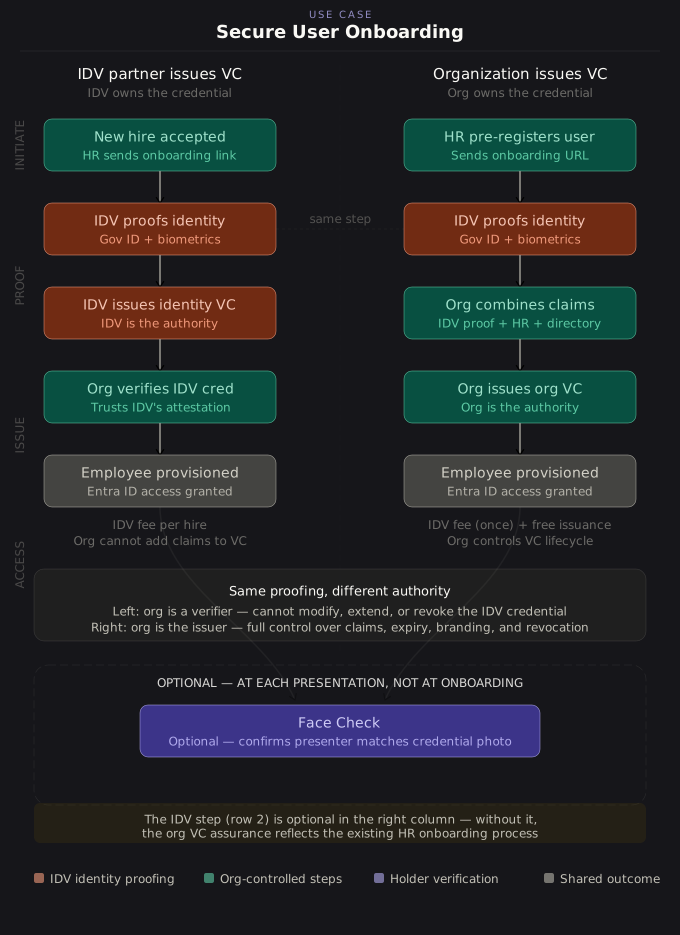
The diagram below maps both models across Initiate, Proof, Issue, and Access phases. Orange steps are IDV-controlled, green are org-controlled, and purple marks holder verification at presentation time. The proofing gap note matters because the IDV step is optional in the right column. Without it, the org VC inherits only the assurance of the existing HR process.
Identity Proofing vs. Holder Verification: The Critical Distinction
Identity proofing occurs at issuance time: Is this person who they claim to be? Document forensics, biometric matching, liveness detection. The outcome is a credential representing a verified real-world identity.
Holder verification occurs at presentation time: Is the presenter the same person the credential was issued to? It does not establish identity again; it confirms that the current presenter is the same person tied to the existing credential. Face Check is the platform's mechanism for this.
Holder verification without identity proofing provides no protection against credentials issued to unverified identities. Identity proofing without holder verification provides no protection against credential theft or transfer. A robust deployment addresses both.
Face Check Is Holder Verification, Not Identity Proofing
Face Check performs a one-to-one biometric match between a live selfie and the photo embedded in the credential. Azure AI Face handles liveness detection. Microsoft describes it as iBeta Level 2 conformant. The Face Check service returns only the match result or confidence score to the verifier, not the live selfie, liveness footage, or a biometric template. The credential presentation itself can still include the credential's claims, including the stored photo claim when that claim is part of the VC. No biometric data is retained after processing.
What Face Check confirms: The presenter matches the credential photo. What it does not confirm: The validity of the original proofing or the presenter's legal identity.
Organizations relying on directory-sourced photos (as with VerifiedEmployee credentials) need profile photos populated in Entra ID before Face Check can be used. Custom credentials can also supply the photo claim directly at issuance time.
Face Check billing triggers when Azure AI processing completes, regardless of whether the match succeeds or fails. No charge is incurred if the flow fails before processing reaches Azure AI, such as QR code errors, user abandonment, or service errors. For organizations with high presentation volumes, the Entra Suite license ($12/user/month) includes 8 Face Checks per user per month pooled at the tenant level, with $0.25 per check for overages, as documented on the Microsoft Entra Verified ID pricing page. That can change the cost calculus significantly compared to pure pay-as-you-go.
Security Store Integration: The Low-Code Path
Security Store partners such as AU10TIX, IDEMIA, and LexisNexis/TrueCredential integrate through the Entra admin portal without custom API work. An administrator selects the provider, procures through the Microsoft Security Store (Azure subscription required), and activates. Microsoft orchestrates the cryptographic exchange.
Pricing: At the time of writing, AU10TIX charges a flat $1.00 per transaction on its Microsoft Security Store listing: successful ID verifications, failed ID verifications, and VC presentations each incur the same rate. Fraud rejections still bill because the IDV completed its work. The free trial includes 100 transactions of each type; pay-as-you-go applies from transaction 101. VC presentations are billed independently from issuance, so verification-heavy workflows accumulate per-presentation cost. API-based partners outside the Security Store negotiate pricing directly; rates vary by volume, geography, and contract terms. Always confirm current rates before sizing any deployment. Security Store purchases are eligible for Microsoft Azure Consumption Commitment (MACC) drawdown.
Both product experiences that currently embed this path, Account Recovery and Entitlement Management Access Packages, are in public preview and subject to change according to Microsoft's account recovery overview and integration guidance for IDV partners. Account Recovery covers lost-auth-method recovery via IDV proofing, Face Check, and Temporary Access Pass issuance. Entitlement Management gates access requests on presentation of a trusted issuer's credential. Custom workflows or non-Security Store partners require the API-based integration path.
Summary
The two issuance models are complementary, not competing. IDV-as-issuer delivers trust portability, data minimization, and identity persistence. It is a better fit for pre-employment proofing, account recovery, regulated contexts, and scenarios where the verifier has no prior relationship with the organization. Org-as-issuer delivers full lifecycle control, immediate revocation, and tight integration with internal systems. It fits workforce credentials and deliberately scoped access decisions within a known trust boundary especially well.
The strongest deployments combine both: an IDV-issued identity credential as a long-lived root of trust, an org-issued relationship credential chained from it for employment-specific claims, and Face Check for biometric holder binding at presentation time. Each layer answers a different security question while keeping trust, liability, revocation, and operational responsibility clearly separated.
References
- Introduction to verifiable credentials architecture | Microsoft Learn
- Plan your issuance solution | Microsoft Learn
- Plan your verification solution | Microsoft Learn
- Integration guidance for IDV partners | Microsoft Learn
- Identity verification partners for Microsoft Entra Verified ID | Microsoft Learn
- Revoke a verifiable credential | Microsoft Learn
- Use Face Check with Microsoft Entra Verified ID | Microsoft Learn
- Microsoft Entra Verified ID pricing | Microsoft Learn
- Account recovery overview | Microsoft Learn
- Verifiable Credentials Data Model v2.0 | W3C